
Current
The Institute of Nuclear Science (hereinafter referred to as "the Institute") is the most historic and distinctive college at our university. It emphasizes fundamental education in physics, chemistry, biology, and engineering, and is characterized by its interdisciplinary integration. With a focus on the peaceful use of nuclear energy and the development of related applied technologies, the Institute has led Taiwan's development in nuclear science, nuclear medicine, and nuclear technology for over 50 years. It is also one of the largest and most comprehensive teaching and research institutions in the field of nuclear science and engineering worldwide.
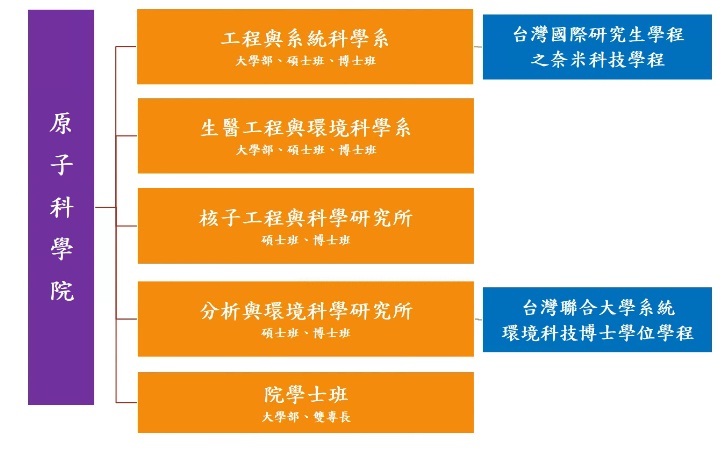
The Institute currently comprises four departments and one undergraduate program, forming five academic units: the Department of Engineering and System Science (DESS), the Department of Biomedical Engineering and Environmental Sciences (DBMES), the Graduate Institute of Nuclear Engineering and Science (GINES), the Graduate Institute of Analytical and Environmental Sciences (GIAES), and the Undergraduate Interdisciplinary Program of the Institute of Nuclear Science (hereinafter referred to as the Undergraduate Program).
In addition, DESS collaborates with Academia Sinica to offer the Taiwan International Graduate Program in Nano Science and Technology (TIGP). The Institute also actively partners with the National Health Research Institutes (NHRI) to jointly offer the Molecular Imaging and Nano-Theranostics (MINT) program. To strengthen international talent cultivation, the Institute established a Ph.D. Program in Environmental Science and Technology, a cross-university collaboration within the University System of Taiwan, supported and operated by GIAES faculty.
Overview of Teaching and Research Focus by Department
|
Department |
Teaching and Research Focus |
|
Department of Biomedical Engineering and Environmental Sciences (DBMES) |
This department integrates interdisciplinary education across mathematics, physics, chemistry, biology, and medicine, combining core engineering practices. It focuses on three areas of specialization: Molecular Biomedical Engineering and Materials, Biomedical Imaging Engineering, and Environmental Molecular Science. Research and teaching emphasize major issues in biomedicine and the environment, responding to global environmental change, advancing smart healthcare and precision medicine, and cultivating interdisciplinary engineering leaders to promote national biomedical and environmental industries and enhance research and development capacity. |
|
Department of Engineering and System Science (DESS) |
This department emphasizes the integration of cutting-edge engineering technologies. The undergraduate program offers four academic specializations—Physics, Thermal-Fluid Science, Materials Science, and Electronics—and four application fields: Solar and Hydrogen Energy, Nuclear Energy, Smart Chip Systems, and Nano-scale Analytical Techniques, which are also the department's key research focuses. In collaboration with Academia Sinica, DESS jointly offers the TIGP Nano Science Program to strengthen nano science education and research. Furthermore, in partnership with TSMC, it offers the TSMC Semiconductor Devices/Integration Program to train the next generation of semiconductor professionals. |
|
Undergraduate Interdisciplinary Program |
This program features a dual-major design. The primary major integrates core courses from various departments within the Institute, focusing on Energy and Environment. The energy curriculum centers on low-carbon and green energy sources, such as nuclear energy, solar cells, and hydrogen energy. The environmental component emphasizes a foundation in chemical sciences and sustainable environmental topics, such as pollutant monitoring, purification, reuse, and their impact on human health. For the secondary major, students may freely choose from core courses offered by other departments in the university based on personal interests or synergy with the primary major, with 43 disciplines across 10 colleges available (e.g., Electrical Engineering, Computer Science, Materials Science, Mechanical Engineering, Finance). This flexible "learn first, choose later" approach nurtures T-shaped talents with strong workplace competitiveness. Through solid dual-major training, students can develop in alignment with their aptitudes and become forward-looking and internationally-minded interdisciplinary professionals in engineering and science. |
|
Graduate Institute of Analytical and Environmental Sciences (GIAES) |
GIAES aims to train master's and doctoral-level professionals with interdisciplinary knowledge and modern technology concepts in energy development, green technology, and environmental ecology and health. With a goal of environmental sustainability, the institute focuses on three key areas in teaching and research: Analytical Chemistry, Ecology and Health, and Green Technology. GIAES collaborates with the NHRI, Environmental Analysis Labs, and government agencies to enhance its teaching and research capabilities. It supports the recruitment of international students for the UST Ph.D. Program in Environmental Science and Technology, integrating expertise from the four universities in the University System of Taiwan. Its research highlights include environmental remote sensing, environmental engineering, environmental chemistry and molecular science, and environmental health and hygiene. The institute promotes environmental education and academic research, cultivating globally competitive professionals in analytical chemistry and environmental technology to address critical environmental challenges and drive sustainable development. |
|
Graduate Institute of Nuclear Engineering and Science (GINES) |
GINES focuses its curriculum on the peaceful applications of nuclear energy, with key areas in nuclear power plant engineering and radiation applications, training specialists in nuclear energy and radiation technologies. Its research priorities include: nuclear power plant decommissioning and spent nuclear fuel disposal, nuclear safety and new/small modular reactors, medical physics and boron neutron capture therapy for cancer, and applications of laser, plasma, and beam science. These efforts aim to meet global low-carbon energy demands while aligning with sustainable environmental development. |